The.Hottest

Joseph E. Bowles ... 1024 pages - Language: English - Publisher: McGraw-Hill; 5th Edition (September, 1995).


The revision of this best-selling text for a junior/senior course in Foundation Analysis and Design now includes an IBM computer disk containing 16 compiled programs together with the data sets used to produce the output sheets, as well as new material on sloping ground, pile and pile group analysis, and procedures for an improved anlysis of lateral piles. Bearing capacity analysis has been substantially revised for footings with horizontal as well as vertical loads. Footing design for overturning now incorporates the use of the same uniform linear pressure concept used in ascertaining the bearing capacity. Increased emphasis is placed on geotextiles for retaining walls and soil nailing.

MATLAB R2024b v24.2.0.2712019 x64 [Size: 12.530 GB] ... MATLAB is a high-performance language for technical computing. It integrates computation, visualization, and programming in an easy-to-use environment where problems and solutions are expressed in familiar mathematical notation.
 
Typical uses include: Math and computation + Algorithm development + Modeling, simulation, and prototyping + Data analysis, exploration, and visualization + Scientific and engineering graphics + Application development, including + Graphical User Interface building. MATLAB is an interactive system whose basic data element is an array that does not require dimensioning. This allows you to solve many technical computing problems, especially those with matrix and vector formulations, in a fraction of the time it would take to write a program in a scalar noninteractive language such as C or Fortran. The name MATLAB stands for matrix laboratory. MATLAB was originally written to provide easy access to matrix software developed by the LINPACK and EISPACK projects, which together represent the state-of-the-art in software for matrix computation. 

MATLAB has evolved over a period of years with input from many users. In university environments, it is the standard instructional tool for introductory and advanced courses in mathematics, engineering, and science. In industry, MATLAB is the tool of choice for high-productivity research, development, and analysis. MATLAB features a family of application-specific solutions called toolboxes. Very important to most users of MATLAB, toolboxes allow you to learn and apply specialized technology. Toolboxes are comprehensive collections of MATLAB functions (M-files) that extend the MATLAB environment to solve particular classes of problems. Areas in which toolboxes are available include signal processing, control systems, neural networks, fuzzy logic, wavelets, simulation, and many others.

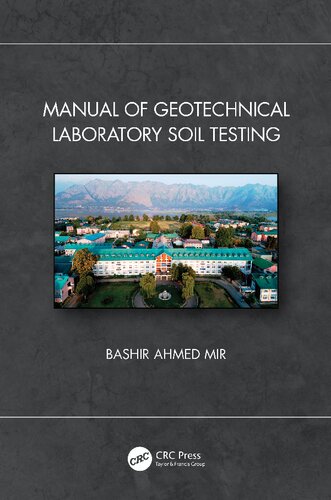
Bashir Ahmed Mir
... 663 pages - Language: English - Publisher: ‎CRC Press; (October, 2021).


Manual of Geotechnical Laboratory Soil Testing covers the physical, index, and engineering properties of soils, including compaction characteristics (optimum moisture content), permeability (coefficient of hydraulic conductivity), compressibility characteristics, and shear strength (cohesion intercept and angle of internal friction). Further, this manual covers data collection, analysis, computations, additional considerations, sources of error, precautionary measures, and the presentation results along with well-defined illustrations for each of the listed tests. Each test is based on relevant standards with pertinent references, broadly aimed at geotechnical design applications.

Features: Provides fundamental coverage of elementary-level laboratory characterization of soils + Describes objectives, basic concepts, general understanding, and appreciation of the geotechnical principles for determination of physical, index, and engineering properties of soil materials + Presents the step-by-step procedures for various tests based on relevant standards + Interprets soil analytical data and illustrates empirical relationship between various soil properties + Includes observation data sheet and analysis, results and discussions, and applications of test results + This manual is aimed at undergraduates, senior undergraduates, and researchers in geotechnical and civil engineering.

William Navidi ... 960 pages - Language: ‎ English - Publisher: ‎ McGraw-Hill; 6th Edition (January, 2023).

Statistics for Engineers and Scientists stands out for its clear presentation of applied statistics. The book takes a practical approach to methods of statistical modeling and data analysis that are most often used in scientific work. This edition features a unique approach highlighted by an engaging writing style that explains difficult concepts clearly, along with the use of contemporary real world data sets, to help motivate students and show direct connections to industry and research. While focusing on practical applications of statistics, the text makes extensive use of examples to motivate fundamental concepts and to develop intuition.

Table of Contents: Chapter 1: Sampling and Descriptive Statistics - Chapter 2: Probability - Chapter 3: Propagation of Error - Chapter 4: Commonly Used Distributions - Chapter 5: Confidence Intervals - Chapter 6: Hypothesis Testing - Chapter 7: Correlation and Simple Linear Regression - Chapter 8: Multiple Regression - Chapter 9: Factorial Experiments - Chapter 10: Statistical Quality Control.

Braja M. Das, Khaled Sobhan ... 819 pages - Publisher: CL Engineering; 9th edition (January, 2017) ... Language: English.

Provide a valuable overview of soil properties and mechanics together with coverage of field practices and basic engineering procedures with Das and Sobhan, Principles of Geotechnical Engineering 9th Edition. This market-leading introduction to geotechnical engineering is ideal for the foundational course taken by most civil engineering students. This book provides the important background knowledge students need to support study in later design-oriented courses and in professional practice. The authors ensure a practical and application-oriented approach to the subject by incorporating a wealth of comprehensive discussions and detailed explanations. Find more figures and worked-out problems than any other book for the course to help ensure student understanding.

Braja M. Das, Nagaratnam Sivakugan ... 944 pages - Publisher: Cengage Learning; 9th edition (December, 2017) - Language: English.


Master the core concepts and applications of foundation analysis and design with Das/Sivakugan’s best-selling Principles of Foundation Engineering 9th (SI) Edition. Written specifically for those studying undergraduate civil engineering, this invaluable resource by renowned authors in the field of geotechnical engineering provides an ideal balance of today's most current research and practical field applications. A wealth of worked-out examples and figures clearly illustrate the work of today's civil engineer, while timely information and insights help readers develop the critical skills needed to properly apply theories and analysis while evaluating soils and foundation design.

Teacher:
Sanjay Singh and Yogita Aggarwal - Language: English - Videos: 396 - Duration: 30 hours and 41 minutes.


SPSS Masterclass: Learn SPSS From Scratch to Advanced is one of the top courses in the footsteps software SPSS statistical analysis to teach you. If you look from day to day increasing value of data and its analysis. Harvard University had predicted in a report in 2012. It was in the same report notes that researchers and statistical analysts will have a special place in the future. Today really happened.

Size is a lot more companies and businesses need to analyze this data to improve their businesses. This course interested in statistics for deep and accurate data analysis software SPSS will become familiar with the discussions. Understanding the different parts of the SPSS statistical applications requires familiarity with and without the knowledge of the sectors that can not be done useful work in the program. In this course topics such as how to understand and gain insight into the business, understanding consumer behavior, brand and even documentation of statistical journals and dissertations are well trained. This course is not specific to a particular class. The students, like students and researchers who have a good understanding of statistics and data analysis to achieve their personal projects can benefit from the concepts discussed in the course.

What you’ll learn: Analysis of numerical data in SPSS + Understand how to design research results for publication in scientific journals + Educational program of basic research + Detailed analysis of data in a standard format

IBM SPSS Statistics 27.0.1 IF026 [Size: 2.35 GB] ...
SPSS stands for Statistical Package for the Social Sciences, and the able package statistical for the Social Sciences is a … SPSS Statistics is a program powerful for statistical analysis is that up to about forty years. by SPSS Inc provided was from 2009, and the takeover of the company by IBM Corporation, first called PASW stands for Predictive Analytics SoftWare was changed, and finally called IBM SPSS Statistics, provided and the. Dating and the ability to the top of the apps, etc. it is one of the most famous and The most popular programs for statistical analysis in various fields of Social Sciences, converter), and managers and researchers to predict the correct future, and so deciding the exact in order to solve problems and enhance the efficiency of the backs.

Facilities and features of the software IBM SPSS Statistics: Ability to manage and document data + Includes descriptive statistics and a variety of other…) and components relevant like Frequencies, analysis, distribution, etc. tests Unparametric or Nonparametric and… + Predicting and calculating the exact Outcomes numerical + Improve model building using the simulation method of Monte-Carlo (Monte Carlo method) + Advanced analysis and accurate data input + Ability to use the programming language Python (provided AS extension apps) + Full support for Standard Unicode + Ability to output to software, common office applications, etc. PDF, and also the possibility of shooting data in the form of formats common video.

B.C. Punmia, Er. Ashok Kumar Jain, Arun Kumar Jain ... 940 pages - Language: ‎ English - Publisher: Laxmi; 17th Edition (December, 2005).

This book first published in 1970 and running into its Sixteenth Edition, has been thoroughly revised, updated and enlarged. The book, divided into Eight Parts, contains Thirty Four Chapters.

This book is intended to present currently accepted theories, design principles and practices of soil mechanics and foundation engineering. The book provides sufficient material ranging from simple to very complex for undergraduate and postgraduate courses. At the end of each chapter, latest problems from various central competitive examinations has been solved to enable the student to test his reading at different stages of his studies.

Contact Form

Name

Email *

Message *

Powered by Blogger.